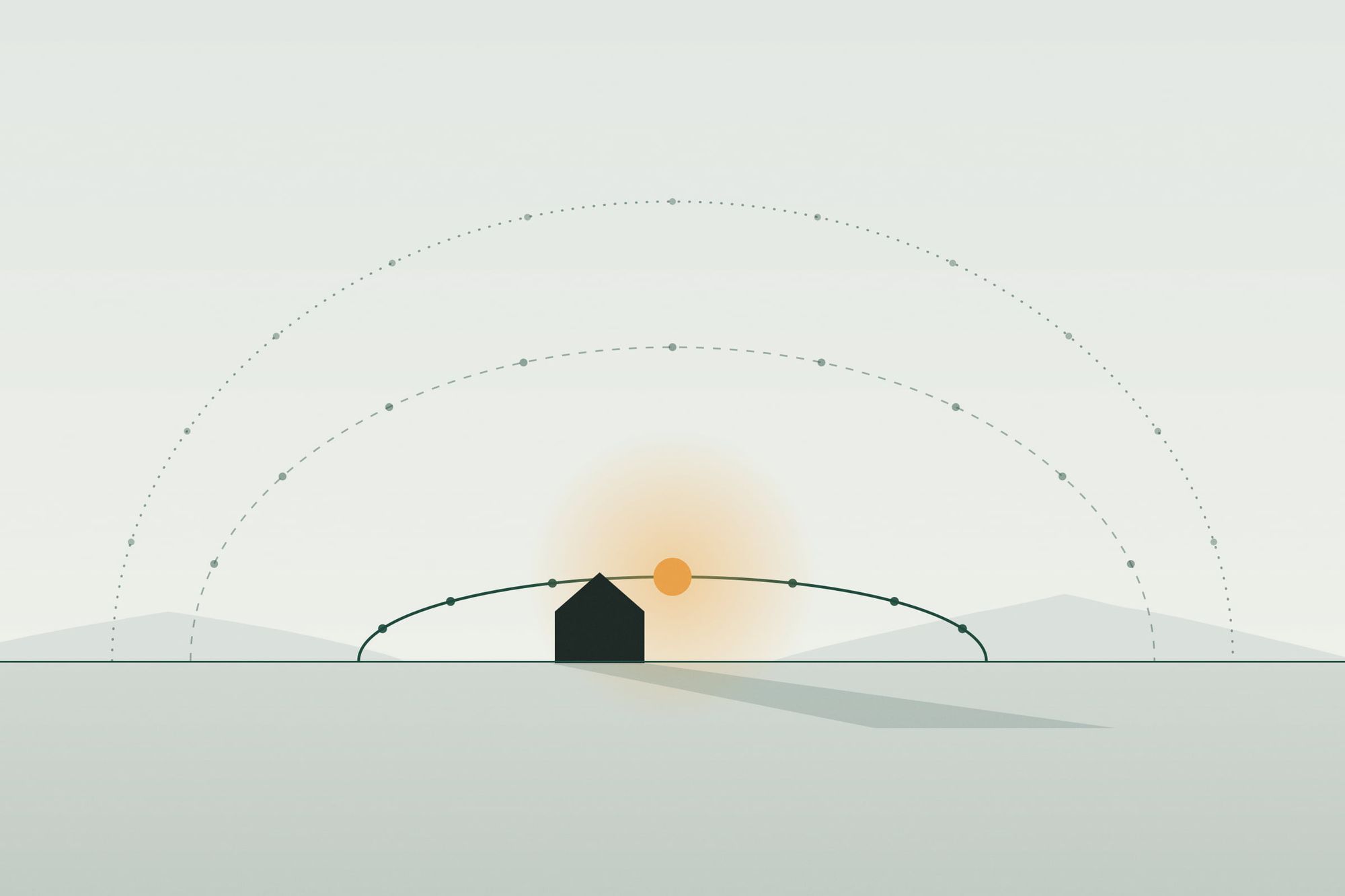
In Oslo, the sun climbs to about 53 degrees above the horizon at midsummer. At the winter solstice it reaches less than 7 degrees at noon. A house in Norway has to work well in both of those worlds, and the winter one is the harder design problem.
Low sun reaches deep
When the sun is low, its light travels almost horizontally. A window facing south in December can throw sunlight several metres into a room, much deeper than in June. We place the rooms where people spend their winter mornings, usually the kitchen and the living room, where that light can actually reach them.
Low sills help. A window that starts close to the floor lets the winter light fall across the floor and up the back wall, which makes the whole room feel brighter.
Overhangs do the opposite job in summer
A roof overhang sized for the high summer sun blocks the midday heat but lets the winter sun pass underneath. The right depth depends on the latitude, the orientation and the window height, so we test it for every site in a simple 3D sun study instead of relying on rules of thumb.
Glare is the real winter problem
Low sun also means glare: light that hits you straight in the eyes across a desk or a dining table. Deep window reveals, light surfaces next to the glass and simple textile blinds usually solve it. Heavy external shading rarely makes sense this far north.
What this means for your project
- Ask for a sun study early, before the plan is fixed.
- Visit the site in December, not only in June.
- Think about where you sit on a winter morning. That is where the best window should be.